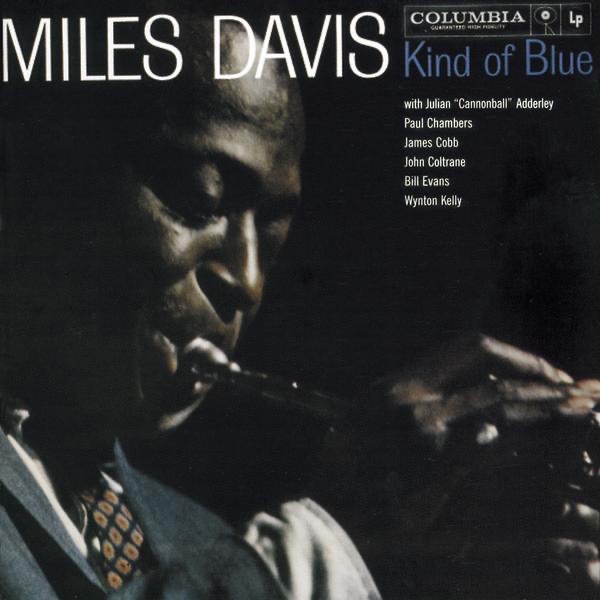
March 1959. Bebop has already transformed jazz into a high-density language — Charlie Parker and Dizzy Gillespie proved that speed could be an aesthetic choice, not merely a display of technique. Miles Davis had moved through that era and come out the other side looking for something else. Birth of the Cool (1949–1950) had already hinted at the value of restraint; Milestones (1958) had begun replacing harmonic complexity with modal scales. Kind of Blue is both the completion of that search and its definitive opening. Where Coltrane, in the same year, would build on Giant Steps a harmonic system of claustrophobic density, Davis chose the opposite direction: he opened the walls, let in the air, and handed six musicians — Coltrane, Cannonball Adderley, Bill Evans, Paul Chambers, Jimmy Cobb — the task of improvising over modal structures that appear simple and are anything but.
The recording sessions span a day and a half, March and April 1959, at Columbia's 30th Street Studio in New York. Davis handed out the lead sheets that same morning, with no rehearsals. The result is music that sounds like it's being composed in the moment of listening. So What opens Side A with a theme carried by Chambers' bass — Davis' trumpet enters after the ensemble's response as if the music already existed before him, and he was simply deciding whether to join. His phrasing is rarefied, each note suspended in its own space as though all alternatives were equally possible. Blue in Green offers the counterpoint: three minutes of muted trumpet and piano in which Evans and Davis build a fragility so precisely calibrated it seems it could stop at any breath. Flamenco Sketches closes the album with five modal scales given over to pure improvisation — it doesn't end. It simply stops sounding.
The original Columbia USA pressing — six-eye label, CL 1355 mono, CS 8163 stereo — remains the historical reference. The mono version carries a midrange presence that the stereo sacrifices for a more open soundstage. The modern benchmark is the Mobile Fidelity MFSL 2-45011 double 45RPM: mastered from a first-generation tape transfer, pressed at RTI, with a soundstage that expands the room and a noise floor that borders on surgical. The transients — trumpet attacks, Cobb's cymbal touches — carry a definition that on cheaper pressings simply dissolves into the mix. The Columbia/Legacy 2015 180g reissue is the accessible option: honest, with Chambers' bass maintaining body and clarity even at higher volumes.
Kind of Blue is the best-selling jazz album of all time — a distinction that in other cases would signal overestimation. Here it means that something in the way Davis organized the space between notes speaks to anyone who has ever truly wanted to listen. The limitation, if one exists, is in the perfection itself: a record this complete leaves little room for the imperfection that makes certain listening experiences visceral. The essential track is Flamenco Sketches — that is where Davis shows what it means to have the courage not to fill the space. Some records wear out. This one, every time you put it back on the turntable, still seems like it has something left to reveal.
- A1So What★
- A2Freddie Freeloader
- A3Blue in Green★
- B1All Blues
- B2Flamenco Sketches★