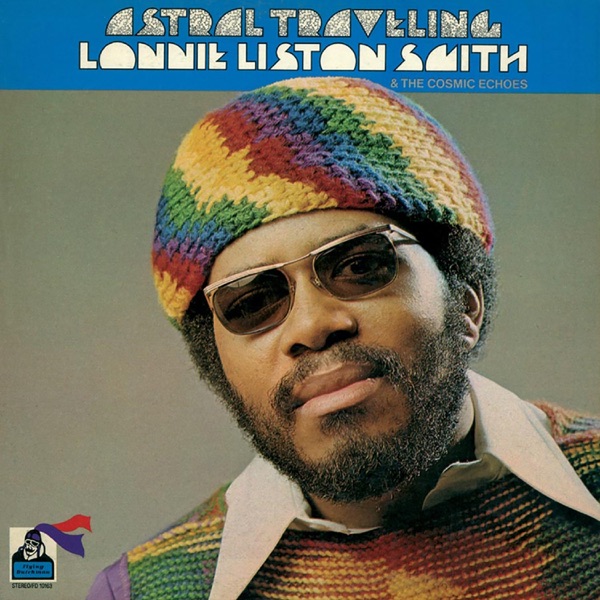
1973. Spiritual jazz had already found its voice through John Coltrane — A Love Supreme (1965, Impulse! A-77) had cracked open a door that no one quite knew how to walk through. Lonnie Liston Smith had walked through it sideways, for years, as a sideman for Pharoah Sanders: on Karma (1969) and Jewels of Thought (1969) he had built his vocabulary — cosmic keyboards, floating grooves, modal harmonies that looked toward Africa and India with equal openness. With Astral Traveling, his debut as a leader on Bob Thiele's Flying Dutchman label, Smith stops commenting and takes the floor. Beside him, Don Cherry on trumpet: together they map an interior space that was already visionary in 1973 and today sounds like an indispensable document.
The title track opens the record with an almost meditative patience: Smith's organ builds a harmonic plateau over which Don Cherry traces lines free from urgency, while the rhythm section moves like an underwater current — present but never intrusive. This is jazz that runs toward no particular destination, because the destination is beside the point: the journey is everything. Beautiful Woman shifts the register toward something more grounded — a hypnotic groove blending soul and African rhythm, Cherry's trumpet entering like a voice joining a conversation already in progress. Peaceful Ones is the record's gravitational centre: piano and strings build a texture warm as silk on skin, with a melody so elemental it sounds as though it has always existed. The balance between structure and improvisation is Smith's real gift — he does not break forms but dissolves them slowly, like salt in water.
The original Flying Dutchman pressing (FD 10144, 1973) has the cutting quality typical of New York jazz from that era: a slight roughness in the upper midrange that with time becomes patina rather than flaw. The bass is restrained, almost Eastern in its discretion, but piano and brass gain in presence and warmth compared to later reissues. The most accessible version today is the BGP/Ace Records reissue, which resolves the original pressing's surface noise issues but introduces compression at the peaks that robs the keyboards of air. For those seeking the best, the original first pressing remains the reference point: an object not without technical imperfections, but authentic in the way the finest live recordings are.
Astral Traveling is not Lonnie Liston Smith's most polished record — later work, especially Expansions (1975), would arrive with more refined production and more deliberate commercial reach. But it is his most necessary: the moment a voice finds itself without yet knowing quite what it will say. Those arriving from Pharoah Sanders, Alice Coltrane, or Sun Ra will find a faithful travelling companion. Those arriving from soul and black music of the Seventies will find a door into jazz that nobody thought to lock. A record that does not age because it was never truly a child of its time.
- A1Astral Traveling★
- A2Beautiful Woman
- A3Peaceful Ones★
- B1A Garden of Peace
- B2Lonnie's Lament
- B3Let Us Go Into the House of the Lord★