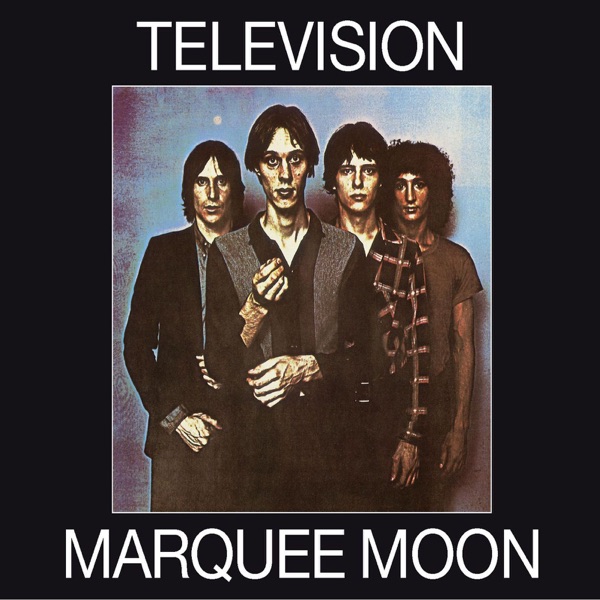
February 1977. CBGB is already a myth in the making, but Television never truly belonged to the scene that had formed around it. The Ramones run at two hundred miles an hour, Patti Smith burns with poetic energy, Blondie eyes the pop surface. Television looks elsewhere — or rather, looks upward. Marquee Moon arrives in the same year punk is about to become a dress code, and it shares nothing with that elemental urgency: this is a record averaging seven minutes per track, built on guitar interplay that owes more to Albert Ayler and modal music than to Chuck Berry. Tom Verlaine and Richard Lloyd had never been heard together on record before, and when their guitars speak on Marquee Moon it is immediately clear they had been waiting for this moment their entire lives.
The record opens with See No Evil and the first ten seconds say everything: Verlaine's riff is nervous, angular, with an articulation unlike anything else in 1977 rock — neither Page's blues-rock suppleness nor Fripp's surgical clarity. It is drier than both, more intellectual, with an almost percussive resonance in the half positions. Lloyd responds with lines that fill precisely the spaces Verlaine leaves empty, like two speakers who never interrupt each other because they have already agreed on who talks when. Venus is the band's romanticism at its most transparent: clean melody, open arrangement, Verlaine's voice riding high above everything with that hoarse, elevated quality — a young Lou Reed who has read too much French poetry. But the title track defines both the record and the entire career: ten minutes in which the two guitarists build, dismantle and rebuild a theme that expands like a nighttime city seen from above, culminating in Verlaine's closing solo — one of the longest and most memorable in the history of American white rock, fast as thoughts and precise as a scalpel.
The original US Elektra pressing (7E-1098, 1977) is the reference version: warm cut, guitars with the right presence in the upper midrange without being bright, Fred Smith's bass solid but never overbearing. The UK Elektra pressing from the same year is considered by many collectors slightly more open in soundstage, with a detail in the guitar overdubs that makes a real difference on headphones. The 2003 Elektra/Rhino reissue is the most findable option: tonally faithful to the original but with modern compression that robs the peaks of dynamics, most noticeably in the Marquee Moon solo. The Music On Vinyl 180g from 2012 has convinced fewer people: a slightly flat midrange EQ, dry but not luminous. If you find a clean US or UK first pressing, do not let it go.
Marquee Moon is one of those records with no real competition within its own genre, because that genre is their invention. It is not post-punk — it precedes post-punk and is already beyond it. It has no direct heirs because no one has ever had the same pair of guitarists, the same narrative patience, the same ability to make harmonic tension physically palpable. Those who approach rock as architecture — elaborate constructions, unexpected geometries, spaces that sound inhabits rather than fills — will find here an essential text. A record that does not age because it was never young in any conventional sense.
- A1See No Evil
- A2Venus★
- A3Friction
- A4Marquee Moon★
- B1Elevation
- B2Guiding Light
- B3Prove It★
- B4Tom Curtain