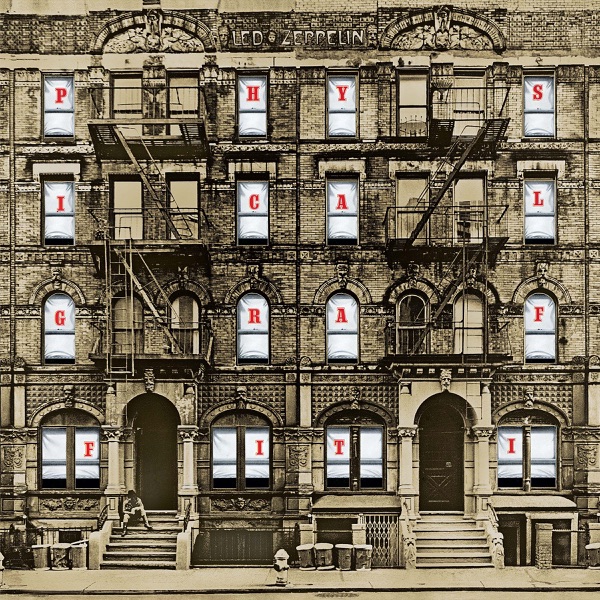
1975 is a year of fractures. Progressive rock is imploding under the weight of its own ambition, punk is rumbling underground, and Led Zeppelin release a seventy-six minute double album that answers none of the passing trends. To understand the leap, it helps to know where they came from: Houses of the Holy (1973, Atlantic K50014) had already demonstrated that the band would not settle for replicating the Led Zeppelin IV formula — funk, reggae, psychedelia coexisted in a single record with a nonchalance their contemporaries struggled to match. Physical Graffiti goes further still: it makes no attempt at coherence because coherence would be a limitation. Where their contemporaries — Pink Floyd's Wish You Were Here, Springsteen's Born to Run — chose concentration, Zeppelin chose expansion. The result is the most ambitious record of their career and, probably, the most honest.
The heart of the record pulses in three tracks that alone would justify the purchase. Kashmir is the clearest demonstration that Jimmy Page had understood something about rhythmic tension his contemporaries ignored: the orchestral riff in 3/4 layered over the rhythm section in 4/4 generates a hypnotic polyrhythm, while John Paul Jones transforms the strings into something Middle Eastern without descending into postcard exoticism. Trampled Under Foot is distorted, sweaty funk, with a Hammond organ thick as asphalt and a wah-wah guitar that breathes like an animal. In My Time of Dying is the blues in its most visceral form: twelve minutes in which Robert Plant screams and whispers with equal urgency, while Bonham builds one of the most physical grooves in rock history. The rest is no less essential — Ten Years Gone has a density of layered guitars that anticipates certain Eighties constructions, and the delicate Bron-Yr-Aur proves that grandeur does not exclude fragility.
The original 1975 Swan Song US pressing is technically problematic: compressed mastering, Bonham's bass losing definition at peak moments, background noise caused by abrasive inner sleeves. The first UK pressing (SSK89400, without Warner logo) is considered by the audiophile community superior for timbral balance and bass depth. The absolute reference for those seeking the best without collector-level spending remains the Classic Records 200g reissue from 2005 — out of print but findable on Discogs: Bonham's drums regain the mass and air they deserve. The 2015 remaster overseen by Jimmy Page is the most accessible choice: it widens the soundstage and improves mid-range detail, but a certain stiffness in the high frequencies penalises it against the best analogue versions.
Physical Graffiti is not Led Zeppelin's most perfect record — Led Zeppelin IV is more focused, Houses of the Holy more elegant. But it is their most truthful record: a band at the peak of its powers that refuses to self-censor, that puts everything in without fear of contradiction. Seventy-six minutes that never run out.
- A1Custard Pie
- A2The Rover
- A3In My Time of Dying★
- B1Houses of the Holy
- B2Trampled Under Foot★
- B3Kashmir★
- C1In the Light★
- C2Bron-Yr-Aur
- C3Down by the Seaside
- C4Ten Years Gone★
- D1Night Flight
- D2The Wanton Song
- D3Boogie with Stu
- D4Black Country Woman
- D5Sick Again